Emergency Smile in Ukraine: April 2026
In April 2026, a team of three Emergency Smile clown artists brought their work to western Ukraine—reaching children and adults across a wide range of settings, from hospitals and orphanages to disability centres and a newly established community space for members of the Romani community.
A country still in motion
The team was based in Uzhhorod, travelling daily in the surrounding areas—sometimes up to an hour and a half away. Western Ukraine has become a place of arrival as well as endurance. Many of the children the team met had only recently left their homes in the east. Some had arrived just four or five days before. Alongside them were people who had been displaced for much longer—older adults, adults with disabilities, families trying to hold routines together in new and unfamiliar places.
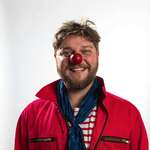
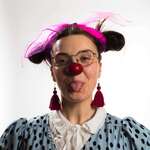
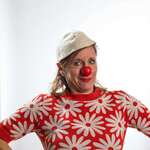
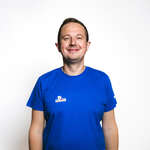
Healthcare clown artists Tina, Vaiva and Aleš worked across all settings, led by Head of Mission Craig.
A show that speaks without words
At the heart of every visit was a 40–45 minute Clown Show, adapted each time to suit the audience. With younger children, the pace stayed fast. With teenagers and adults, there was more room to improvise, to extend a moment that was working, to let a joke breathe.
None of the team spoke Ukrainian hence the show was built on visual comedy and slapstick—moments where the audience knew something the clowns didn't. In one recurring sequence, one clown played a bird whistle while the other two searched the room for the source of the sound. Forty children pointing and shouting at once, all of them in on the joke.
Balancing birds became a thread running through many of the visits. Whatever else was happening in a child's day, the birds seemed to hold their attention completely—a small, steady point of focus in the middle of everything else.


With children recently arrived from the east
The team visited the same organisation three times, working with different groups of children each time—separated roughly by age. With teenagers, the show opened up: more improvisation, more back-and-forth, more space for the kind of humour that rewards an audience paying close attention. With younger children, the energy moved faster and the structure held firmer.
These were children who had, in some cases, left their homes less than a week earlier. They sat and watched, laughed and pointed.
With adults and children with disabilities
Several visits took the team to disability centres—some for children, some for adults, some for both. At Caritas, which supports adults with mental disabilities, a man with Down syndrome came up during the show and became, the fourth artist. He gave the artists instructions, corrected them, helped distribute the balancing birds to fellow participants at the end. The applause was for him!
At the Rehabilitation Centre for children and youth with disabilities, ‘Doroha Zhyttia’ (Way to Life), the feedback from staff was striking—not just that the children had engaged, but how completely. The artists' ability to hold the room, across different ages and different needs, was what stayed with people afterwards.
Vaiva describes one visit where the team arrived expecting children and found a room of 70 to 80 men with mental disabilities. It was not what anyone had prepared for. The show began anyway.
'From the beginning I thought, what will happen here. But at the end, it was the most beautiful performance we had for me. The energy—somehow, love in the air, light in the air.'
By the final song, the men had joined the artists on the stage. A teacher sat down at the piano and found the chords. Everyone moved together in one long train around the room.
With children living in care
At one of the orphanages the team visited, the artists split into two groups after the show—Aleš taking the older children to one side to learn juggling, while Tina and Vaiva worked with the younger ones on balancing birds and the parachute. Different ages, different attention spans, different kinds of absorption. Teenagers given scarves and clubs to juggle with go quiet in a particular way. Younger children running under a billowing parachute go loud in a different one.


With members of the Romani community
The visit to the BLAGO Roma Centre (Charity Foundation) was one of the team's first encounters with a newly established space—set up in a container, still finding its shape. The Romani community in the region has often been overlooked, including in access to services and support. What the team found was a group of children who got the visual jokes immediately—quicker, in some ways, than almost any other audience that week. The more the children responded, the more the artists gave them. The show kept expanding. was one of the team's first encounters with a newly established space—set up in a container, still finding its shape. The Romani community in the region has often been overlooked, including in access to services and support. What the team found was a group of children who got the visual jokes immediately—quicker, in some ways, than almost any other audience that week. The more the children responded, the more the artists gave them. The show kept expanding.
A teacher who had begun the session quiet and guarded was, by the end, laughing openly alongside the children.
With children at 'Zirochky na Zemli'
The 'Zirochky na Zemli' NGO (Stars on the Earth) provides an educational space for children with autism and other mental disabilities. Vaiva describes it as one of the sessions that stayed with her longest.
'You have to work with them differently. A few of them were in their own world throughout—and that was okay. We knew where we were going.'
At the end, the artists took the children by the hand and walked them in a circle, singing together. It was a simple thing. Parents and teachers watched from the edges of the room.
'I was looking into the eyes of everyone and they were really, really enjoying this—just walking in the circle. And even that girl who was really in her own world—when we started to sing her name, she listened. Maybe for half a minute. And then she went back. But even that half a minute—we won her, even for thirty seconds.'
With veterans
Bedside visits to the rehabilitation and surgery departments at two hospitals brought the team to a different kind of room. Men recovering from injuries, in wards that carry a particular weight. Aleš's physical comedy—'stupid things', as Vaiva says, warmly—cut through the atmosphere in a way that surprised people, including the artists.
'They were like children. They enjoyed it. It was very nice to see them laughing.'
Over 400 children and 200 adults reached
The team worked with audiences ranging in age from toddlers to people in their eighties and nineties—through the Regional Service for Children's Social Protection, hospital rehabilitation, surgery, ophthalmology and otolaryngology departments, and partner organisations including Caritas, Doroha Zhyttia, Zirochky na Zemli, and the BLAGO Roma Centre.
In a context where so much has been disrupted and so much remains uncertain, the work was not about grand gestures. Not one audience, not one kind of need. Just a team that kept showing up, adapting, and finding the moment that worked. The moments that stayed were rarely the loudest. They were the ones where someone who hadn't expected to laugh, laughed—and for a little while, that was the whole world.
Work like this is only possible with the support of people who believe in it. If you would like to help us reach more people, consider supporting Emergency Smile.