#MeetTheArtist: Nina Sabo
Meet Lila, Nina Sabo's clown. Lila can be soft and gentle one moment and roaring like Rocky Balboa the next! For Nina, the red nose is simply who she'd be if she were brave enough. Ten years in, she's still discovering what that bravery can do.
 Enlarge photo
Who is your clown character?
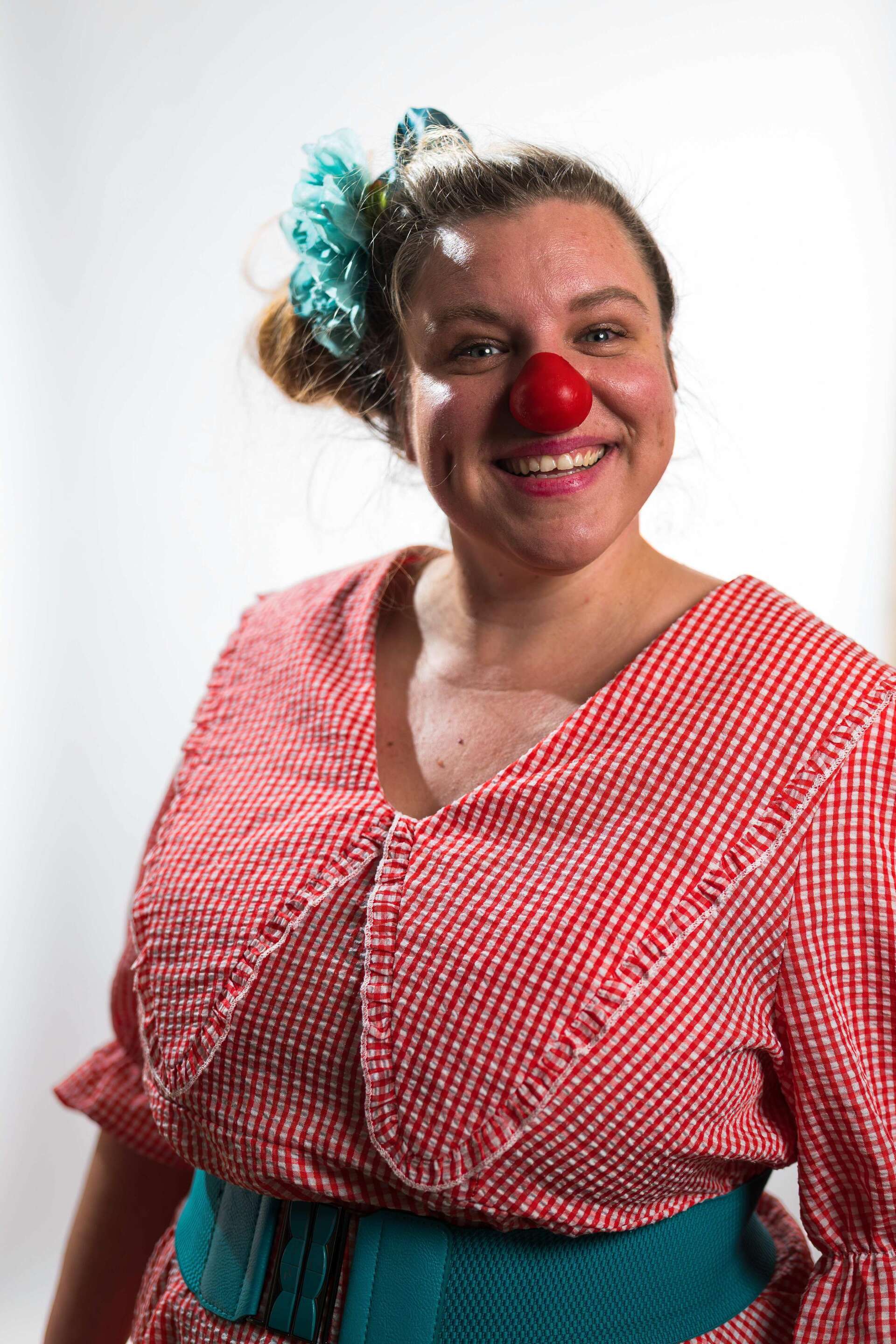
My clown name is Lila. I didn't really choose her as a character. I chose the name, but who she is, is simply who I am without a mask. When the usual social norms fall away, that's when Lila comes through. I always say she's who I'd be if I was brave enough, if I wasn't overthinking everything, if I had a little more self-confidence. A wilder, more colourful version of me!
She's full of polarity. She can be gentle, soft and quiet—a little bundle of fluff. But then, on the other side, her favourite song is 'Eye of the Tiger', because deep down she'd like to be Rocky Balboa! She can be loud, a bit rough around the edges, even a little mean— never with malice, just cheeky, like a teenager testing the limits. And honestly, that's me too, in a way.
Why did you choose this character, and what superpower does she have?
Her superpower is landing on her feet, whatever the situation. Some people sit so firmly on one end of the spectrum—all softness, or all edge—that they can't cross to the other side. I think what I bring is the ability to hold both, and to move between them depending on what's needed.
How do you prepare for your work?
I've been doing this for almost ten years now, with RED NOSES Croatia. Over time, it settles into your body. Putting on the nose doesn't take long. But it also depends on what happened before. I'm a chronic overthinker, so if something's happened that morning, I might need a bit more time to land.
Music usually helps. Sometimes I start with a little parade of my own, or take five minutes to dance as Lila. That's often the thing that gets me out of my head, when I'm stuck there. It doesn't always work, but when it does, it brings me back into my body instead of trying to solve all the world's problems, which I obviously can't do. Singing and dancing ground me, that's my way in, whatever the day looks like.
 Enlarge photo
 Enlarge photo
 Enlarge photo
What impact do you hope to have?
I think in terms of the micro world—small moments of connection where the magic happens, and how that ripples out, both for the other person and for me. We always give, but we receive just as much, sometimes more.
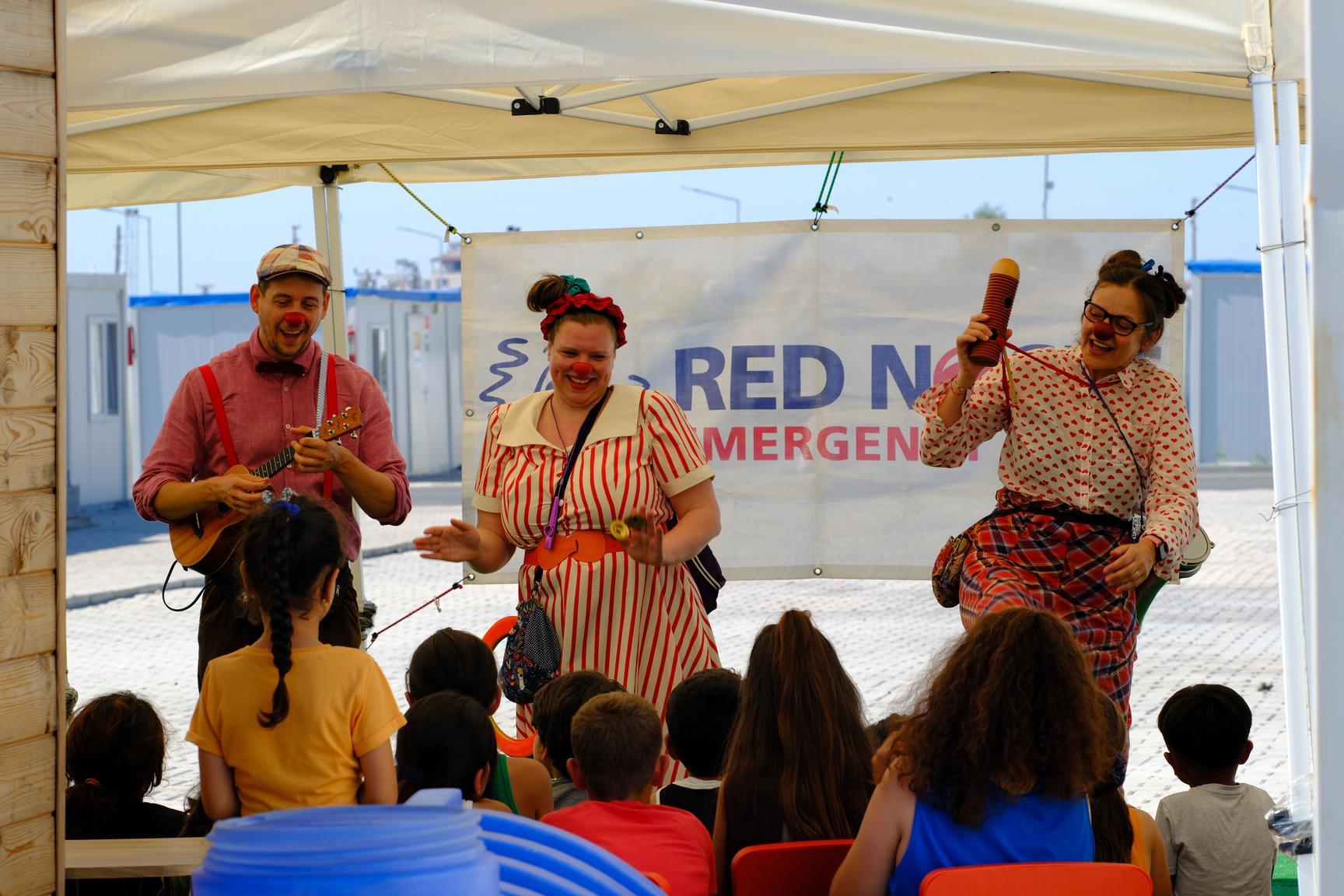
I've worked with children on the autism spectrum for four or five years with RED NOSES, often one-on-one, because each child has such a specific need in that moment. It's made me realise that everyone—neurotypical or not—has very individual needs; it's just easier for us to adapt to a shared situation. Even during our visits with Emergency Smile, I've always enjoyed parades the most, because even amid the chaos, I can find that one small moment: I'm just with you now. For a child who's mostly in survival mode, that kind of attention is a real luxury. That's the impact I hope to have: little moments of magic that come from somewhere, and somehow stay.
What message do you wish to share with the people you meet through your clown?
It's hard to put into words. It's more a feeling, or a mesh of feelings. Something like: we are here, we see you, we feel you, you're not alone. I see your resilience, your kindness, even with everything you're carrying. And I learn so much in return: about people, about myself, about the world.
How do you stay motivated during challenging situations?
Before every visit, I always ask to go somewhere more challenging rather than somewhere calm and predictable. I think I'm just highly motivated by this work! The harder the situation, the more it seems to bring out of me. It keeps me on my toes, and it makes it very clear to me why I'm there.
I think I thrive in a bit of chaos, even though it also brings me anxiety and stress. There's a visual clarity to it—being among the ruins, seeing children who've never been to school, who are already mothers at twelve—it's heavy, and it makes me sad, but it also makes complete sense to me to be there. In that kind of unknown, I don't have time to overthink things, which is actually a healthier kind of stress for me than the version I carry in daily life.
Does Lila show up in your everyday life?
It's impossible for her not to, because she is me. But being Lila also gives me a freedom I don't usually allow myself without the nose. In daily life I'm always trying to do everything right, the best way possible. Clowning is about failing and that gives me a freedom that spills over, in small ways, into how I live. With time, I notice myself becoming a little more clumsy, a little less rigid, in the everyday. Lila is less a different side of me than a different reality, mostly in how I feel inwardly, more than what people see from the outside.
Why does clowning make sense in a crisis setting?
I think it always makes sense. Something like ninety per cent of people have never seen anything like it before, there's this moment of genuine surprise. We arrive with no agenda, just to connect, to try and clear some of the energy in a place where chaos already exists.
In Turkey, we rarely returned to the same place twice, but on our last visit we did, twice. The first time we arrived, people started singing a song we'd taught them a month earlier. A few days later, on our second visit, they were already showing us tricks and games they'd invented themselves in between. That's what I always think about: what stays after we leave, because we're only there for an hour. I think of it as bringing colour and playtime, but if we can leave something behind—even made from things we find there—that people can keep using and adapting once we're gone, that's what matters. If nothing stays, it was just a party, and then it's an ordinary hard day again tomorrow.
 Enlarge photo
What inspired you to become a healthcare clown artist?
In my twenties, I studied philosophy and religion first, and then went on to study acting, which had always been my real dream. During my acting studies I went to every workshop I could find, including a theatre clown workshop and I fell in love with the freedom of it straightaway. Later, a friend who was already working in the field told me about an audition for a healthcare clowning course, and I went, almost without knowing what it meant. Looking back, I think these things choose you rather than the other way round.
Acting on stage started to feel shallow to me by comparison. Fun, but ultimately, in the grand scheme of things, not where I wanted to put my energy. Healthcare clowning felt therapeutic in a different way, disconnected from performance for its own sake. I never know what a day will bring—I might start a morning with no idea I'll spend the afternoon making up a song with a little boy on the oncology ward, simply because he'd just used the toilet for the first time in a while and it felt like something worth celebrating together. Those aren't things you can prepare for at home. Staying open, listening, and not walking in with a fixed script—that's what keeps this alive for me.
Can you share a moment when you felt your work had a lasting impact?
There's a moment I keep coming back to—a huge parade in Turkey, with a child in a wheelchair, where someone caught a photo of me from behind, walking beside them. It was one of our very first activities on that visit, and I still remember how many people were there; we barely had space to walk between them all.
I always try to steal small moments like that, just you and me, now, for a few seconds, in the middle of everything. It reminds me of being a child myself at a concert, when a singer I loved looked straight at me in a crowd of hundreds, and for a moment I felt like the only person there. I think that's what I try to offer, thirty-five years later: you are the special one, even if only for a breath.
Find out more about our artists and our Emergency Smile team!