Emergency Smile in Greece: April/May 2026
Lesvos, Greece, sits at one of Europe's most active points of arrival for people crossing from Türkiye by sea. It is a crossing that has become increasingly dangerous, with more and more pushbacks occurring at sea. Those who arrive are placed in the Mavrovouni Closed Controlled Access Centre (CCAC), on the eastern coast of the island.
 Enlarge photo
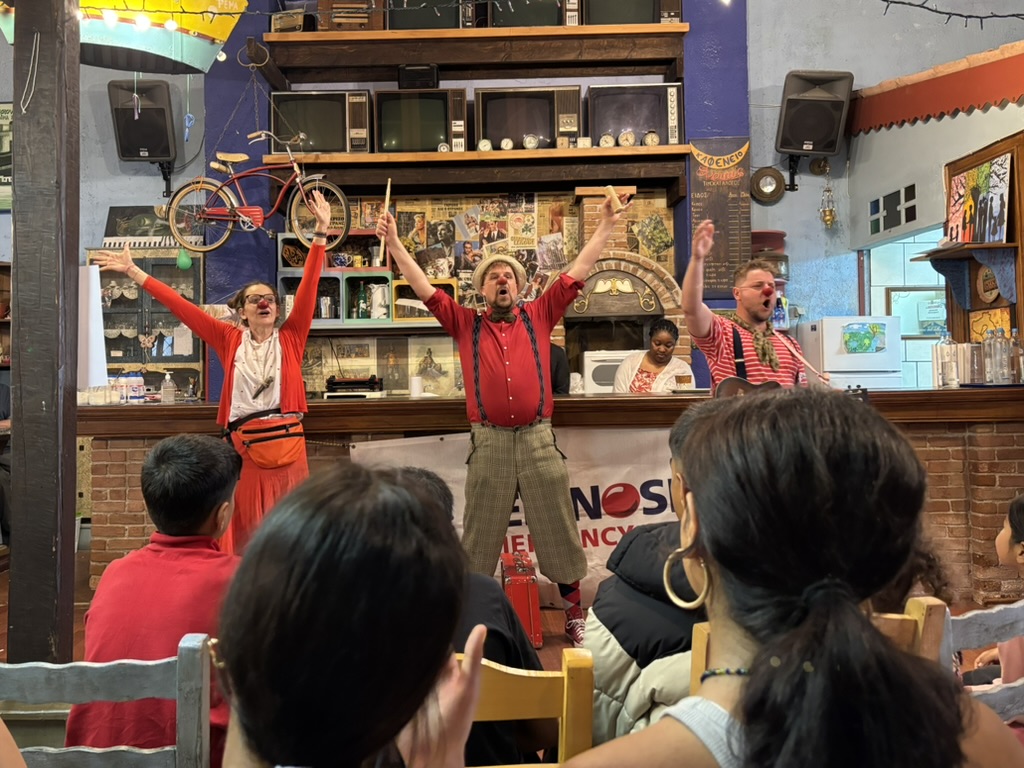
Clown Show for children and adults in the Siniparxi community space
In April and May 2026, the Emergency Smile team returned to this Greek island. Over several weeks, our healthcare clown artists worked with children, adolescents and adults and aid workers across the island—bringing moments of connection, play and relief to people navigating some of the most difficult circumstances imaginable.
Lesvos: a shifting context
During the team's time on Lesvos, the population of the camp was gradually decreasing. Fewer people are managing to reach the island, and those who do tend to stay for a shorter period than before. Despite this, people living in the camp continue to face significant hardship—with persistent shortages of food, clothing, and hygiene items—and several non-governmental organisations remain present on the island to respond to these needs.
Unaccompanied minors—children and teenagers travelling alone—are accommodated into dedicated shelters in the island's capital, Mitilini. Since March 2026, very few unaccompanied minors have been arriving on Lesvos; most are now reaching Greece via Crete.
Who we worked with
The team worked with a wide range of people across the island, from children living in camp shelters to adults at community spaces in Mitilini, as well as aid workers from several organisations.
People participating in activities came from Afghanistan, Sudan, Somalia, Yemen, Syria, Morocco, Egypt, Cameroon, Guinea, and other countries. Around 80 children took part across the visit, along with an estimated 320 adults—some of whom participated in multiple activities. Approximately 50 unaccompanied minors living in shelters in Mitilini took part, along with 12 adults with disabilities at a local centre, and 30 children at a kindergarten. 84 aid workers joined Humour Relief Workshops, with around 80 additional staff and volunteers supporting or observing activities throughout the visit.
 Enlarge photo
 Enlarge photo
 Enlarge photo
Working with unaccompanied minors
The team, comprising Salomé as Head of Mission and artists Majka, Daniel and Aleš, visited four of the five shelters for unaccompanied minors on the island, all run by Iliaktida—an organisation that operates shelters for young people as well as a centre for adults with disabilities. Three of the shelters house teenage boys between 14 and 17 years old; the fourth welcomes girls and younger children, some as young as four.
At the shelters for older boys, a familiar pattern emerged: initial hesitation giving way to laughter. The clown artists held Clown Shows, followed by Circus Smile sessions where the young people could try juggling, spinning plates, and other circus skills. Some boys then became teachers themselves—passing on a newly learned skill to a fellow resident!
One moment stood out. A 13-year-old boy from Syria arrived at a session seeming shy and unsure. He sat down for the Clown Show, then tentatively picked up a spinning plate. Within a short time, he was absorbed—practising with one of the clown artists until he had mastered it. He stayed until the very end of the activity.
For many of these young people, the experience of letting go—of being silly, surprised, and delighted—is not a small thing. These are teenagers who often had to grow up very quickly. The Clown Shows offered them a rare opportunity to reconnect with something younger and lighter in themselves.
The team visited the shelter for girls and younger children three times, allowing trust and connection to build with each return. Some of the children recognised the team from a previous visit in October–November 2025 and showed photos they had preciously kept from that time.
Community spaces in Mitilini
Because activities cannot take place inside the Mavrovouni CCAC directly, three community spaces, close to Mitilini, serve as vital access points—places where people living in the camp can reach the team's activities.
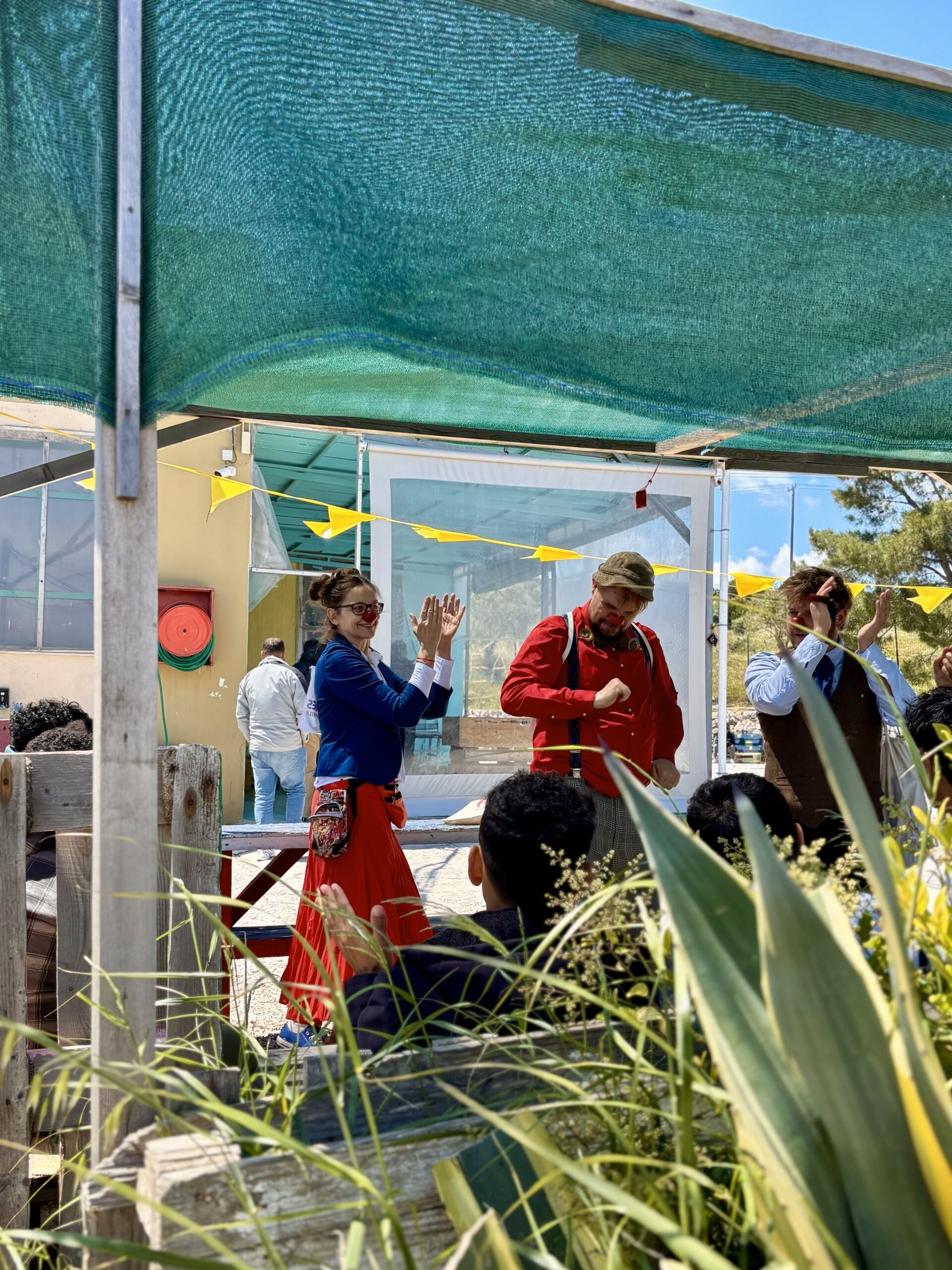
Paréa Community Centre, run by Europe Cares, was visited seven times. Paréa is a space where people come for access to food, health support, clothing and simply a place to rest. The clown artists moved through the space with Musical Parades, circus props, and magic tricks. Each visit, the team also spent time in 'the Nest'—the centre's child-friendly space. By the end of the visit, RED NOSES had become a familiar presence: children and adults began to recognise the artists and opened up more readily; some staff started to join in with circus skills of their own.
Siniparxi, a community space inside a former taverna in Mitilini, was new territory for the team—a first-time collaboration with an organisation that welcomes both camp residents and people living in the city. The team visited Siniparxi five times, hosting Clown Shows that drew audiences of up to 90 people, with children and adults watching and joining side by side. By the second and third visits, children who had seen the team before greeted the artists with the show's song already on their lips.
Ariadni Lesvos, a smaller house in the city that hosts regular activities for children living in the camp, welcomed the team for one visit. The Clown Show was met with audible delight—laughter could be heard throughout Ariadni’s building.
Working with adults
At Paréa and Siniparxi, the team also worked with adults—many of them living in the camp and accustomed to holding themselves with a certain guardedness that difficult circumstances demand. Magic tricks, performed with foam red noses, proved particularly effective. 'Tough' and serious-looking men became giggling and animated within moments. It is a shift the team has seen many times in many places—and it never loses its power.
Iliaktida's disability centre
The team also organised two activities at a disability centre for local adults with disabilities, run by Iliaktida. The sessions were warmly received—festive in atmosphere, with attentive staff and an especially interactive Clown Show that ensured every participant was genuinely part of the performance, not just a spectator.
Supporting aid workers
Humanitarian aid work is demanding. The people doing it—across all the organisations present on Lesvos—carry a great deal. This visit included seven Humour Relief Workshops with staff from five partner organisations: Iliaktida, Yoga and Sport with Refugees, Europe Cares, Eurorelief, and a joint session for partner organisations working together at Paréa—Europe Cares, Terra Psy, Makerspace Lesvos, and Defence for Children International.
The workshops offer something rare in this context: a moment to step back from the weight of the work, to laugh together, to be surprised by each other, and to say—out loud—what is valued in a colleague. Most workshops included a moment for team members to offer one another genuine compliments. It is, by many accounts, one of the most quietly powerful parts of the day.
These workshops are also part of a wider research project, which began during the team's previous visit to Lesvos in October–November 2025, exploring the impact of healthcare clowning on humanitarian aid workers. The research continued during this visit.
A song that travels
One small detail captures something important about the visit. The team created a simple, catchy song—'dambi dambi'—for their Clown Shows and parades. It spread quickly. Children and adults picked it up almost immediately. By the second or third encounter, people were greeting the team with it. It became a kind of shared language: short, joyful, and entirely its own.
 Enlarge photo
Shared music at Paréa community centre